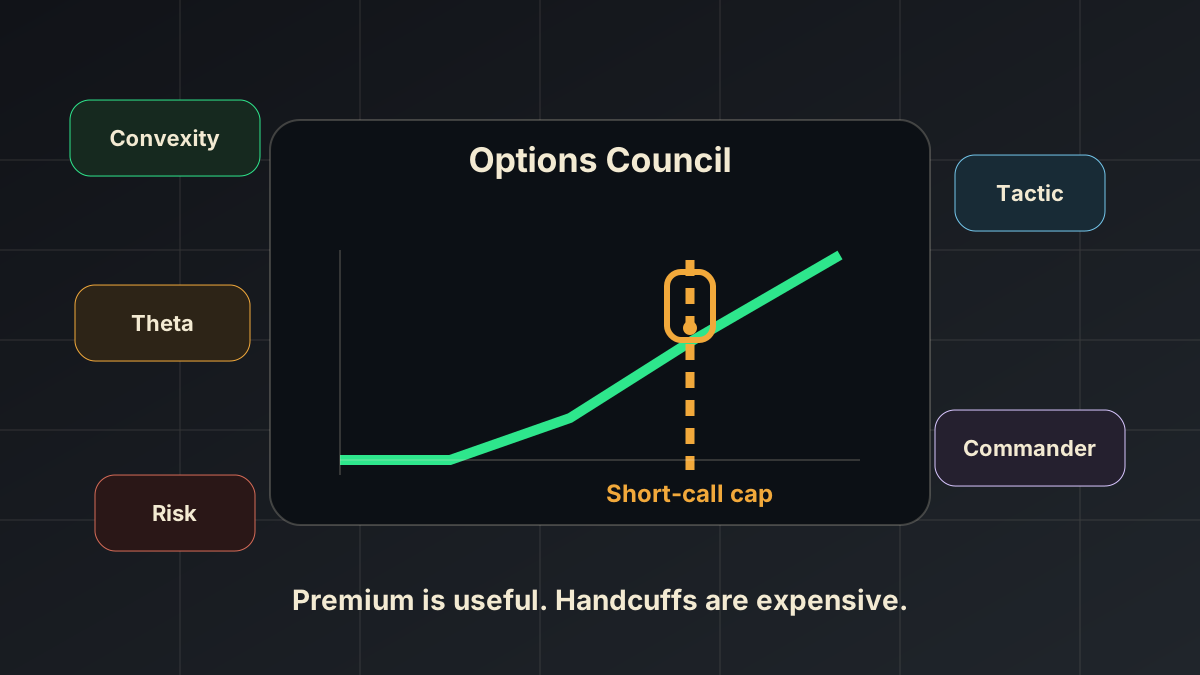
The Options Council: Premium Is Useful, Handcuffs Are Expensive
The trade structure matters as much as the idea
One of the biggest lessons I have learned from trading options is that being directionally right is not enough.
You can find the right stock, build conviction early, and still manage the position in a way that strangles the upside.
That is especially true with LEAPs and short calls.
My natural bias is toward long-dated convexity. I like structures where the downside is defined and the upside can get strange if the thesis starts working. LEAPs fit that personality because they give an idea time to become obvious.
But once you own long calls, it is tempting to sell short calls against them to finance the position.
That can be smart.
It can also become a trap.
Premium is not automatically progress
Selling calls feels productive. You collect premium. You reduce basis. Waiting turns into a little cash register, which is exactly how the trap gets baited.
The question is not “can I collect premium?” Of course I can. The market will happily pay me to sell away the part of the trade I actually wanted.
The better questions are uglier:
- Am I selling the wrong part of the distribution?
- Am I capping the move I bought the LEAP for?
- How much theta is left compared with the upside I am giving away?
- Is this financing, or is this a handcuff?
- If the stock rips tomorrow, will I be proud of this structure or annoyed at myself?
That last one gets to the truth fast.
A short call is fine if I am genuinely willing to sell the upside above that strike. It is not fine if I am selling it because I am bored, nervous, or trying to squeeze income out of a position whose real job is convexity.
Why I want an Options Council
This is why the trading dashboard needs an Options Council.
Not one generic AI answer. A real internal debate.
The council should argue from a few angles at once. One voice protects the right tail. One asks whether premium is actually worth harvesting. One checks sizing, liquidity, assignment, and downside. One compares rolls and alternate structures. Then a commander writes the decision log so I cannot quietly rewrite history later.
The point is not to make trading complicated. The point is to keep one emotional voice from grabbing the wheel.
When a position is working, the Theta Farmer will always find a reason to sell calls. The Convexity Bull needs a seat at the table too.
The Short Call Warden
One agent I especially want is the Short Call Warden.
Its job is to watch every covered-call or diagonal-style position and flag when the short call is becoming the boss.
It should look for things like:
- short strike too close to spot
- short call already in the money
- little extrinsic left to harvest
- assignment risk approaching
- roll candidates with better upside room
- situations where waiting for theta is rational
- situations where waiting is just denial
The Warden should not tell me to panic. It should tell me what is true.
Example output:
Short Call Warden verdict:
The short call has shifted from financing to handcuff.
Remaining theta is small relative to upside cap risk.
Recommended actions: close partial, roll higher, or define a price trigger.
That kind of warning beats another price chart. A chart shows the bruise after the punch. The Warden should catch the fist moving.
The rule I want built into the system
The rule is simple:
LEAPs/core convexity are the exposure engine. Short calls are financing tools, not handcuffs.
That does not mean never sell calls. It means the short call needs a job description before I sell it, not a story I invent afterward.
Acceptable jobs:
- reduce basis after a large move
- finance more time
- harvest premium against a partial position
- define an exit zone I actually accept
- protect against a likely pin or stall
Bad jobs:
- calm my nerves
- make me feel productive
- chase income because the market is boring
- cap a thesis before the thesis has had a chance to get weird
Turning pain into product
This is where the dashboard becomes more than a personal tool.
A lot of options traders understand the pain of being right but capped. They understand the feeling of collecting a little premium and then watching the underlying run through the short strike.
That means the Short Call Warden could eventually become its own product:
- enter your long call and short call
- see cap risk, theta left, assignment risk, roll choices
- get a plain-English warning when the structure no longer matches the thesis
The product tagline writes itself:
Premium is useful. Handcuffs are expensive.
For now, I am building it for myself.
But the best tools usually start that way.