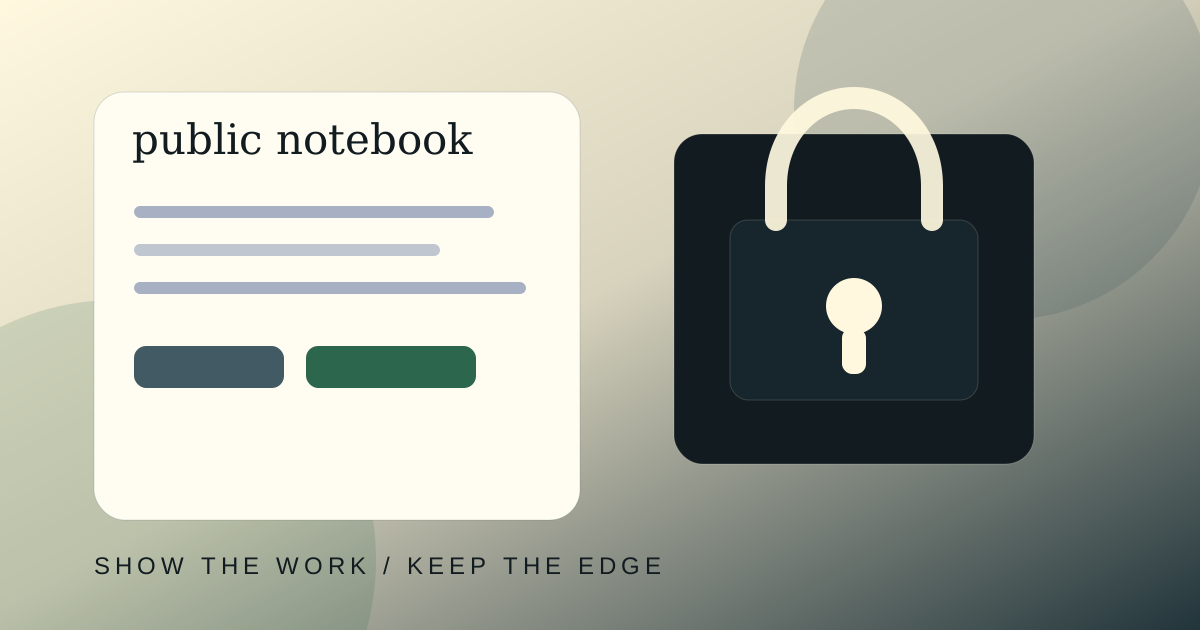
Public Proof Without Giving Away the Playbook
Building in public gets weird once the work starts touching real decisions.
If you are making a toy app, publish everything. If you are writing a tutorial, show the steps. If distribution is the edge, maybe the playbook can be the marketing.
Small Town Capital is not that.
The public version should earn trust. The private version has to protect judgment.
So I need a line.
The site is a receipt layer
BenBrannen.com is not here to be a hype machine.
It is a place to leave receipts.
A good public receipt can show what I am studying, what I am building, how I think about risk, why sources matter, and where I got something wrong.
It does not need to show every model, every watchlist rule, every private workflow, every account detail, or every tactical decision.
Proof of work is not the same thing as proof of edge.
The useful middle
The useful middle is specific enough to be real and careful enough not to leak the guts.
I can write about decision logs without publishing the whole private decision log.
I can write about short calls becoming handcuffs without turning a live structure into content bait.
I can write about public records without turning open questions into accusations.
I can write about Waynesboro without pretending every idea is ready for campaign mode.
That is the lane: process, principles, receipts, lessons.
Not signals. Not instructions. Not a treasure map.
Publishing is pressure
The best reason to publish is not attention. It is pressure.
Public writing asks an annoying question: can I explain this cleanly without exaggerating it?
If I need mystery, jargon, or fake certainty to make an idea sound good, the idea probably needs more work. If a post sounds like it is trying too hard to be smart, that is a warning. If a claim cannot survive a source check, it should not be on the site.
That makes the public layer useful to the private one. It tightens the language. It exposes weak thinking. It leaves a timestamp on what I believed before the outcome was obvious.
The rule
Show enough of the machine to prove the reps are real. Keep back the parts that create unnecessary risk.
No live position theater. No private account screenshots. No copy-trade breadcrumbs. No pretending agent research is magic. No public certainty when the honest answer is still, “I am investigating.”
The better public voice is quieter:
- here is what I saw
- here is how I framed it
- here is the source trail
- here is what would make me wrong
- here is what changed after the mistake
- here is what I am building next
That is enough.
I am not trying to become loud. I am trying to become legible.
Why it matters
Small Town Capital is still an early operating identity. It does not need to look bigger than it is. It needs to become more disciplined than it was.
That is a better promise.
A polished site can lie. A receipt trail is harder to fake over time.
So the public layer should keep getting cleaner: better essays, sharper visuals, fewer vague claims, more honest notes about what is still unfinished.
Public enough to build trust.
Private enough to protect the work.