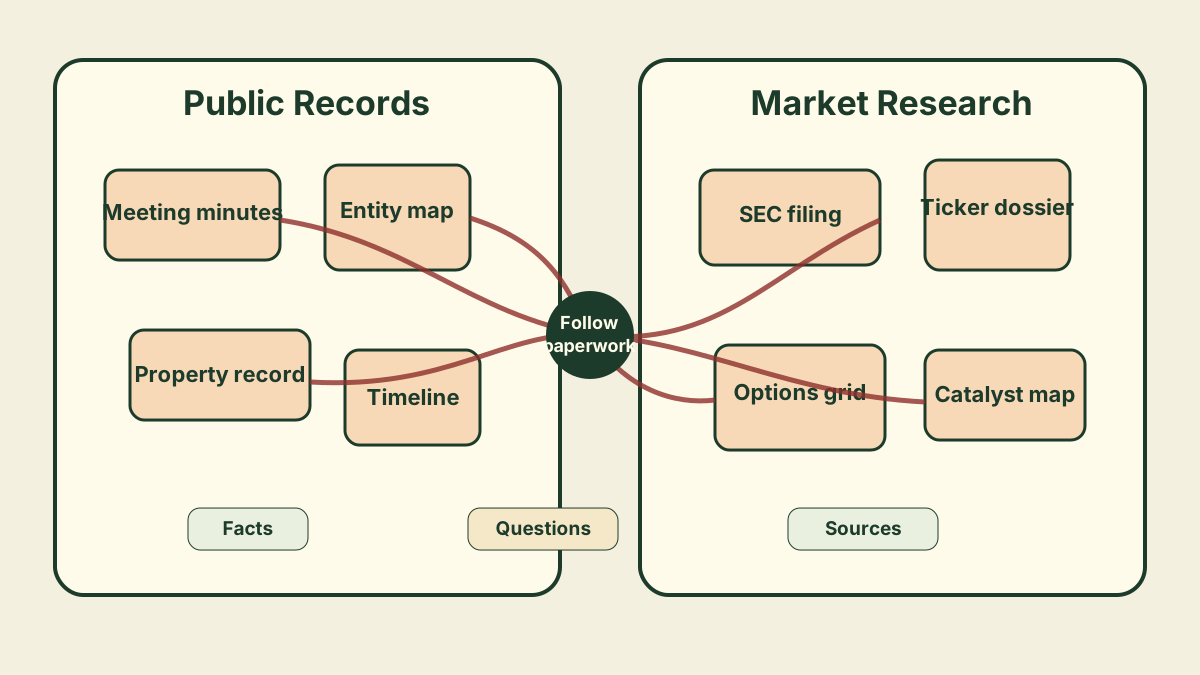
From Public Records to Market Research
Follow the paperwork
One thing I keep coming back to is that good research usually starts with boring documents.
Public records. SEC filings. Meeting minutes. Property records. Corporate entities. Option chains. Earnings transcripts. Old announcements nobody bothered to connect.
The documents are not always exciting by themselves, but the patterns can be.
That is why my local public-record projects and market research projects do not feel separate to me. They train the same muscle.
Follow the entities. Follow the money. Follow the incentives. Follow the paperwork.
Local intelligence as a research laboratory
A town is a surprisingly good research laboratory.
You can watch how decisions get made. You can see how development projects move through meetings, permits, budgets, and public narratives. You can compare what people say with what the records show.
The goal is not to accuse recklessly. The goal is to organize public information so clearly that patterns become easier to see.
That means separating:
- verified facts
- observations
- open questions
- source links
- timelines
- entity relationships
That same discipline applies to investing.
A ticker is also a public-record object. A company leaves trails through filings, presentations, insider transactions, supply-chain hints, and market behavior.
Why this belongs inside Small Town Capital
Small Town Capital is about overlooked systems.
A small town can be overlooked. A small-cap stock can be overlooked. A weird options chain can be overlooked. A public filing can be overlooked. A local property record can be overlooked.
The edge is not pretending to know everything.
The edge is building a machine that remembers what was found, where it came from, and why it matters.
That machine should eventually include:
- market dossiers
- public-record timelines
- source trackers
- entity maps
- catalyst calendars
- trade decision logs
- local deal radar
- postmortems
Different surfaces, same research spine.
The dashboard version
For market research, the dashboard should turn a ticker into a living dossier.
A good ticker page should include:
- why the name entered the system
- price/volume context
- options-chain battlefield
- recent filings
- catalyst map
- bull case
- bear case
- risk flags
- structure ideas
- decision log
- review notes
The important part is provenance. If a claim matters, it should link back to a source.
That prevents the dashboard from becoming a vibes machine.
The public-record version
For local research, the same logic applies.
A useful public-record page should include:
- the claim or question
- the source document
- date and entity names
- what is verified
- what is inferred
- what remains unanswered
- links to related records
The goal is clarity, not drama.
If the record is strong, the record can speak for itself.
Building the intelligence habit
The more I work on these projects, the less impressed I am by one big idea.
The useful skill is capture and review.
When something interesting appears, capture it. When a source supports it, attach the source. When a thesis changes, log the change. When a trade closes, review the decision.
Most people lose the thread because the work is scattered across screenshots, browser tabs, text messages, notebooks, and memory.
The machine should keep the thread alive.
The long-term direction
I want Small Town Capital to become a system that can move between markets and local intelligence without changing its basic philosophy.
The philosophy is:
Find what is mispriced. Build the machine to understand it. Position before the crowd. Document the process. Let the winners get weird.
That can apply to a stock, a website, a property, a local story, or a business opportunity.
The paperwork is not the whole game.
But it is usually where the game starts.