Building the Small Town Capital Intelligence Machine
The projects are less scattered than they look
From the outside, the work can look like separate piles:
- a private stock dashboard
- options-chain analysis
- local public-record research
- automation scripts
- websites
- market notes
- YouTube/content ideas
- eventually, Small Town Capital
It does not feel separate from the inside.
I am trying to build an intelligence machine for overlooked systems.
Sometimes the system is a small-cap stock with a weird options chain. Sometimes it is a local development story buried in public records. Sometimes it is a dashboard that keeps breaking because the workflow was never clean. Sometimes it is a trade that worked and still got overmanaged.
The loop is simple:
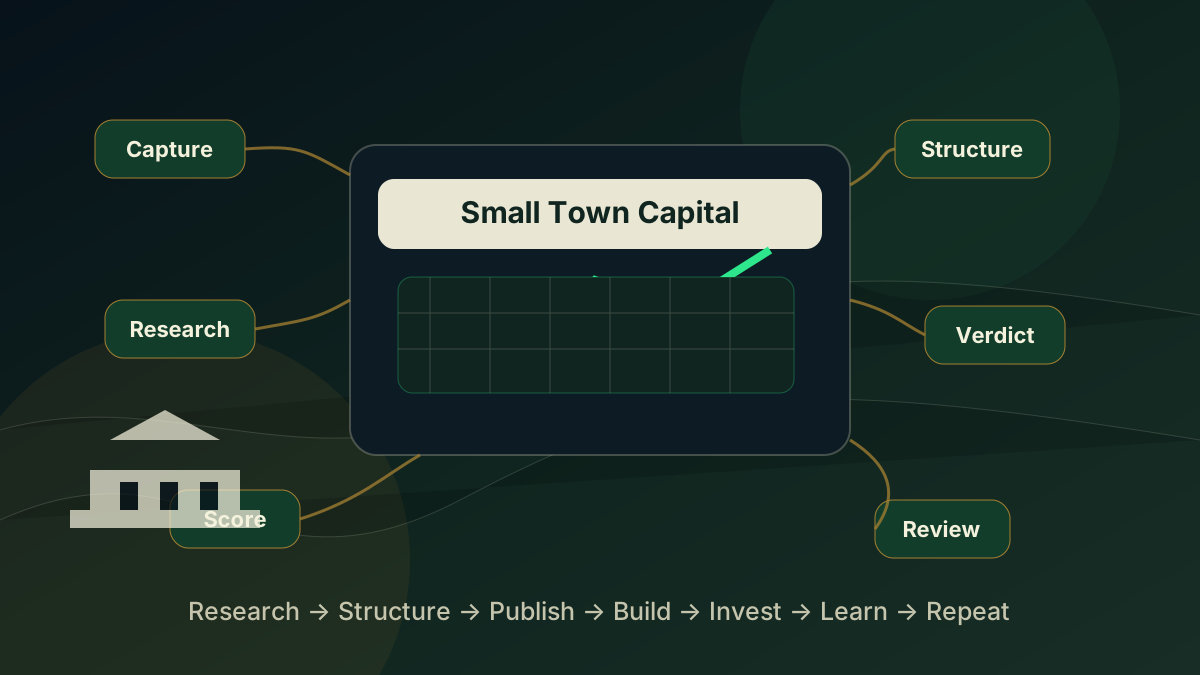
Research → structure → publish → build → invest → learn → repeatSmall Town Capital as the umbrella
Small Town Capital is more than a possible fund name. It is the operating identity for the work.
You do not need to be in New York, Miami, or Silicon Valley to notice mispriced things. You need curiosity, discipline, systems, and enough patience to follow the paperwork after everyone else gets bored.
The first version is private: a command center for market ideas, watchlists, options structures, trade reviews, and research dossiers.
The public version is this: essays, trade lessons, research notes, local intelligence writeups, and build logs.
The long version is a capital platform. But that is later. The work right now is building the judgment layer one artifact at a time.
What the dashboard needs to do
The stock dashboard is not supposed to be another watchlist with green and red numbers.
It needs to answer better questions:
- Why is this ticker here?
- What is the thesis?
- What would make me wrong?
- What would make this violent?
- What structure fits the idea?
- Is the options chain liquid enough?
- Am I harvesting premium or handcuffing myself?
- What did I learn after the trade?
The operating flow is:
Capture → Research → Score → Structure → Verdict → ReviewThe review loop is the part most dashboards skip. Without it, you are just collecting tickers and calling it a process.
Why agents belong in the system
The trading agents I want are not robots that place trades.
They are research desk workers.
A few examples:
- Screener Scout finds odd setups.
- LEAP Oracle checks long-dated options and convexity.
- Short Call Warden warns when premium financing turns into a handcuff.
- Options Council argues through structures from different angles.
- Dossier Builder turns ticker chaos into sourced research.
- Postmortem Judge forces the review after the emotion wears off.
The rule is simple: agents prepare decisions. I approve decisions.
That keeps the machine useful without pretending automation should replace judgment.
The lesson so far
The biggest recent trading lesson has been this:
LEAPs and core convexity are the exposure engine. Short calls are financing tools, not handcuffs.
Premium is useful. But premium gets expensive when it caps the exact move I was positioned for.
That lesson belongs in the product. The dashboard should show option prices, but it should also warn me when the structure starts fighting the original thesis.
What comes next
The next phase is turning the ideas into artifacts:
- a private command center that improves decisions
- trade autopsies that document wins and mistakes
- public essays that explain the process
- research dossiers that can become content or investor material
- tools that might become products later
I do not want to look like a polished finance influencer.
I want to build the thing, document the process, and let the work compound.
Small-town intelligence desk. Hedge fund notebook. Garage-built Bloomberg Terminal for weirdos.
That is still the direction.