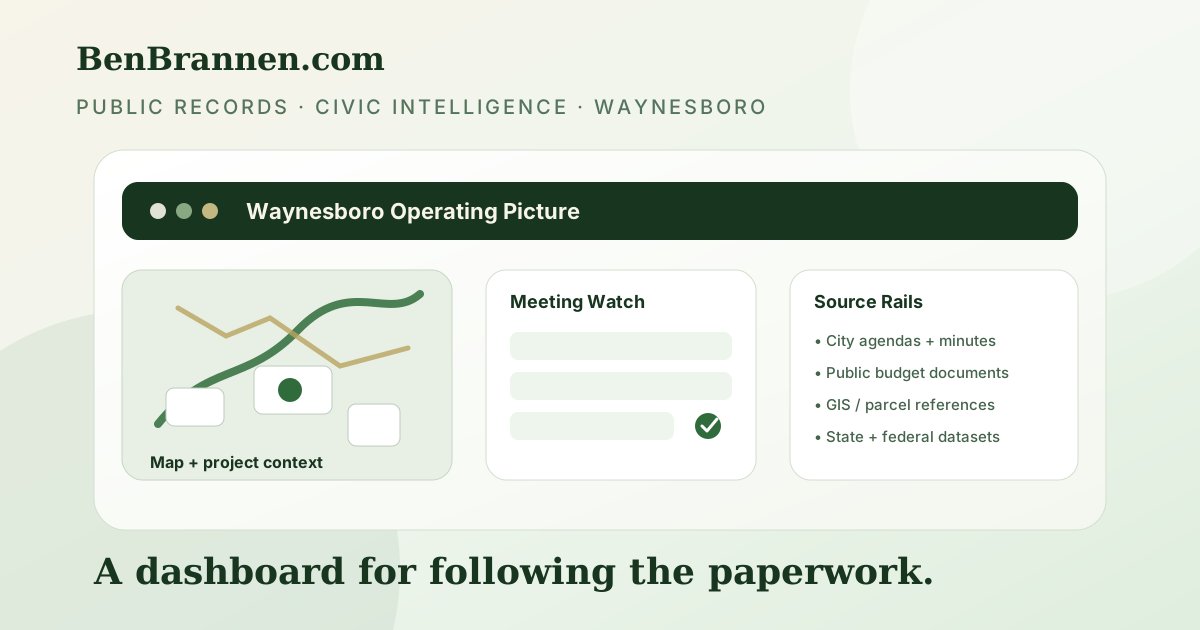
A Public Dashboard for Waynesboro
I have been working on a public dashboard for Waynesboro, Georgia.
You can open it here: Waynesboro Public Dashboard
The simple version is this: I wanted one place where residents could get a clearer operating picture of what is happening locally without having to dig through a dozen separate websites, PDFs, agenda packets, public databases, and map tools.
This is not meant to be a gossip page. It is not meant to replace the city website. It is not a finished civic-tech product with every answer already solved.
It is a public-information dashboard: a way to organize useful local context, point back to source data, and make the paper trail easier to follow.
What the dashboard is trying to do
Most local information is technically public, but that does not mean it is easy to use.
A resident might need to check one place for meeting agendas, another place for minutes, another place for property records, another for economic data, another for state datasets, and another for project or development context. Even when the information is available, it is usually scattered.
The dashboard is my attempt to start pulling those threads into one view.
The goal is to help answer basic civic questions like:
- What meetings or agenda items should people be paying attention to?
- What projects, properties, or development areas are worth tracking?
- What does the public data say about the local economy, population, housing, and budget context?
- Where did a claim, number, or note come from?
- What is verified, what is just context, and what still needs more source work?
That last part matters. A good dashboard should show where the information came from, not ask people to trust a summary.
What is in it right now
The dashboard is still early, but the structure is starting to take shape.
It includes sections for:
- City meetings and agenda awareness, so important public discussions are easier to notice.
- Local project and development tracking, for items that may matter for Waynesboro’s future.
- Property and parcel context, using public GIS or property references where appropriate.
- Budget, demographic, and economic indicators as context, not a final verdict.
- Source links, so the dashboard points back to original public records.
The long-term version should feel less like a static website and more like a small civic operating picture: a place where public information becomes easier to inspect.
The source data
The dashboard is built around public source material.
That can include:
- City council and public meeting agendas
- Meeting minutes and packets
- City budget or planning documents
- Public GIS and parcel/property information
- State and federal datasets
- Public economic and demographic data
- Other cited government or public-record sources
The important rule is that public-facing claims should be source-backed. If something is uncertain, approximate, incomplete, or still needs verification, the dashboard should say so.
That is the line I want to keep: organize the record clearly, but do not pretend the dashboard knows more than the source data supports.
Why I built it
I am interested in overlooked systems.
Sometimes that means markets. Sometimes it means small businesses. Sometimes it means public records. Sometimes it means a local development story hiding in plain sight.
Waynesboro is a good test case because it is small enough to understand, but complex enough that no single person can keep the whole civic picture in their head. There are meetings, projects, budgets, property decisions, development incentives, demographic trends, and local stories all moving at once.
A dashboard gives those pieces somewhere to live.
It also creates a habit: follow the paperwork, separate facts from assumptions, and keep improving the map.
What this is not
It is worth being clear about the boundaries.
This is not an official city website. It is not affiliated with the City of Waynesboro. It is not legal advice, investment advice, or a final authority on anything.
It is a citizen-built tool for organizing public information.
If something is wrong, outdated, missing, or poorly framed, I want to fix it. The point is not to dunk on anybody. The point is to make the public record easier to see.
Where it goes next
The next version should get better in a few ways:
- Cleaner source citations
- Better meeting and agenda tracking
- More useful project pages
- More careful property and map overlays
- Better mobile presentation
- More explicit notes about data freshness and limitations
- A clearer split between verified facts, observations, and open questions
That is the standard I want for this kind of work: useful, sourced, calm, and clear.
If you want to look around, here is the dashboard again:
Open the Waynesboro Public Dashboard
If you see a public source, meeting item, project, or dataset that should be included, send it my way. This is the kind of tool that gets better as the map gets better.